If you are comparing Brachiaria grass vs Boma Rhodes, you are likely trying to decide which pasture grass offers better milk production, drought tolerance, profitability, and long-term farm sustainability.
These two forage giants dominate livestock farming discussions in Kenya and across East Africa, but they perform very differently depending on climate, soil, and management.
This in-depth guide breaks down everything you need to know, including growth habits, protein content, yield, palatability, establishment costs, and best use cases so you can confidently choose the right grass for your dairy or beef farm.
Understanding The Two Forage Giants
What is Brachiaria Grass?
Brachiaria grass (also known as the Urochloa species) is a highly nutritious tropical forage originally developed in Africa and South America. It is widely used for:
- Dairy cattle feeding
- Beef production
- Silage and hay making
- Soil conservation and erosion control
Popular varieties include:
- Brachiaria brizantha
- Brachiaria humidicola
- Brachiaria decumbens
- Brachiaria hybrid (high-yielding improved types)
What is Boma Rhodes Grass?
Boma Rhodes grass (Chloris gayana) is one of the most widely grown fodder grasses in Kenya. It is known for:
- Fast establishment
- High biomass production
- Good hay quality
- Adaptability in semi-arid regions
It is especially popular for:
- Hay production for dairy farms
- Grazing systems
- Dryland farming areas
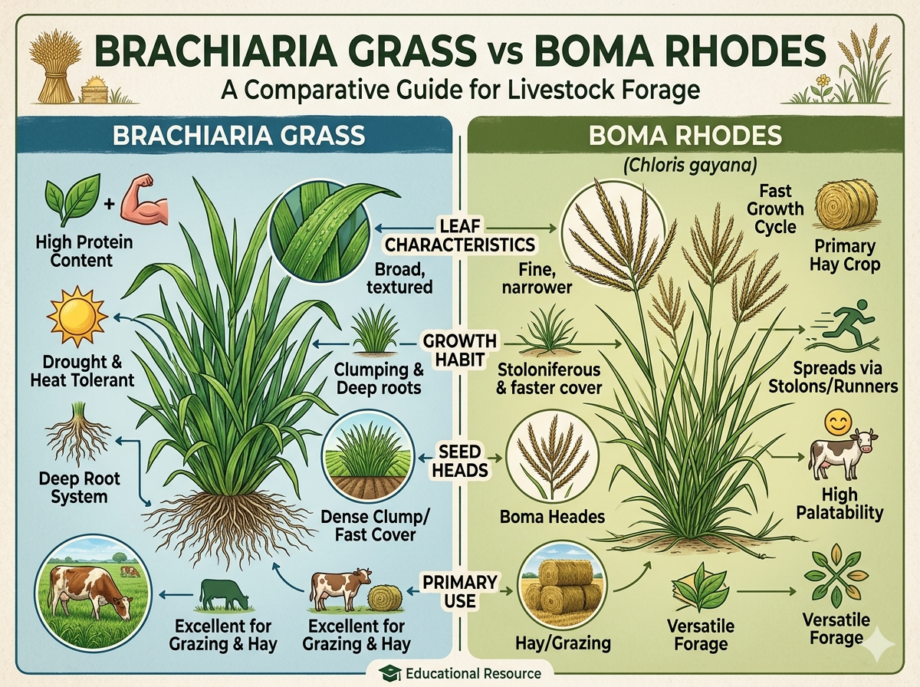
Brachiaria Grass vs Boma Rhodes: Quick Comparison Table
| Feature | Brachiaria Grass | Boma Rhodes Grass |
|---|---|---|
| Protein content | Higher (10–16%) | Moderate (6–12%) |
| Drought tolerance | Very high (variety dependent) | High |
| Establishment speed | Moderate | Fast |
| Yield per hectare | Very high | High |
| Palatability | Excellent | Good |
| Soil improvement | Excellent (deep roots) | Good |
| Best use | Intensive dairy & beef | Hay & grazing |
| Fertilizer needs | Moderate | Low–moderate |
Growth Performance Comparison
1. Growth Rate And Establishment
Boma Rhodes grass has the advantage in early establishment. It germinates quickly, often within 5–10 days under good conditions, making it ideal for farmers who want fast ground cover or quick hay production.
Brachiaria grass, on the other hand, takes slightly longer to establish but compensates with long-term productivity and persistence. Once established, it can outperform Rhodes in biomass production.
Summary:
- Fast results → Boma Rhodes
- Long-term yield → Brachiaria
2. Nutritional Value And Milk Production
This is where Brachiaria grass clearly stands out.
- Higher crude protein (especially improved hybrids)
- Better digestibility
- Higher energy content
- Improved milk yield when used in dairy rations
Dairy farmers often report increased milk production when switching from Rhodes grass to Brachiaria, especially when the Brachiaria is properly managed with fertilizer and rotational grazing.
Boma Rhodes still provides decent nutrition, but it is generally lower in protein compared to Brachiaria.
3. Drought Resistance And Climate Adaptability
Both grasses perform well in dry regions, but there are differences:
Brachiaria Grass
- Deep root system improves drought survival
- Performs well in low rainfall areas (depending on variety)
- Handles poor soils better
Boma Rhodes Grass
- Highly drought-tolerant once established
- Performs well in arid and semi-arid lands (ASALs)
- May go dormant in extreme drought
Winner: Brachiaria (overall resilience)
4. Yield Per Acre
Yield is a major decision factor for farmers.
- Brachiaria grass can produce extremely high biomass under good management, especially hybrid varieties.
- Boma Rhodes grass produces consistent but slightly lower yields per cut.
If your goal is maximum forage production per acre, Brachiaria generally leads.
5. Palatability And Animal Preference
Livestock performance depends heavily on how much they actually eat.
- Brachiaria grass: Highly palatable, soft leaves, better intake
- Boma Rhodes grass: Palatable but slightly fibrous at maturity
Animals tend to consume Brachiaria more readily, which improves weight gain and milk output.
6. Establishment Cost And Maintenance
Boma Rhodes Grass
- Cheaper seeds
- Easier to establish
- Lower input requirements
Brachiaria Grass
- Seed is more expensive
- Requires better management during establishment
- Higher fertilizer response
If you are a beginner farmer or a low-budget farmer, Rhodes may be easier to start with. But Brachiaria pays more in the long run.
Best Use Cases: Which Grass Should You Choose?
Choose Brachiaria Grass if:
- You run an intensive dairy farm
- Want high milk production
- Have reliable rainfall or irrigation
- Long-term pasture investment
- You are focused on soil improvement and sustainability
Choose Boma Rhodes Grass if:
- You want quick pasture establishment
- Producing hay commercially
- Farm in semi-arid or dry regions
- Want low-cost forage production
- Need reliable grazing grass for beef cattle
Brachiaria Grass vs Boma Rhodes For Dairy Farming In Kenya
In Kenya’s dairy zones like Nyandarua, Uasin Gishu, Nakuru, and Kiambu, farmers are increasingly shifting toward Brachiaria grass due to:
- Higher milk yield
- Better resilience during dry spells
- Reduced feed costs over time
However, Boma Rhodes remains dominant in ASAL regions like Kajiado, Narok, and parts of Eastern Kenya due to faster establishment and drought resistance.
Management Tips For Maximum Yield
For Brachiaria Grass:
- Apply nitrogen fertilizer after each cut
- Use rotational grazing
- Avoid overgrazing during the establishment phase
- Harvest at 6–8 week intervals
For Boma Rhodes Grass:
- Cut at the early flowering stage for the best hay quality
- Apply manure or nitrogen to boost regrowth
- Irrigate where possible during dry spells
- Maintain proper spacing during planting
Common Farmer Questions (FAQs)
1. Which is better, Brachiaria grass or Boma Rhodes?
Brachiaria is generally better for nutrition and milk production, while Boma Rhodes is better for fast establishment and hay production.
2. Which grass produces more milk in dairy cows?
Brachiaria grass produces more milk due to its higher protein and digestibility.
3. Is Brachiaria grass good for dry areas?
Yes, certain varieties are highly drought-tolerant, though Boma Rhodes still performs better in extreme dry zones.
4. Which grass is best for hay production in Kenya?
Boma Rhodes is widely used for hay because it dries easily and establishes quickly.
5. What is the lifespan of Brachiaria grass?
With good management, Brachiaria pastures can last 4–8 years or more.
6. Does Brachiaria grass need fertilizer?
Yes, it responds very well to nitrogen and manure application.
7. Can you mix Brachiaria and Rhodes grass?
Yes, many farmers mix both to balance fast feed supply (Rhodes) and high-quality nutrition (Brachiaria).
Final Verdict: Brachiaria vs Boma Rhodes
Both grasses are excellent—but they serve different farming goals:
- Brachiaria Grass = High-performance dairy, nutrition, and long-term productivity
- Boma Rhodes Grass = Fast establishment, hay production, and dryland reliability
The smartest farmers in Kenya are now combining both systems to balance short-term feed supply and long-term pasture productivity