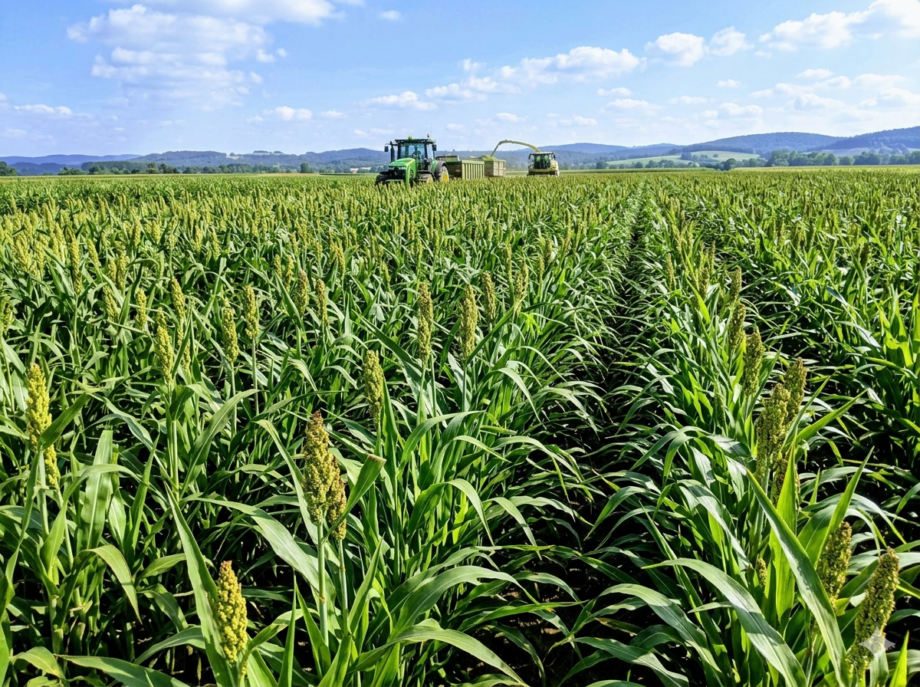
Sudan Grass is one of the fastest-growing and most productive fodder crops for livestock farmers looking to increase milk production, improve animal nutrition, and reduce feed shortages. Known for its drought tolerance, rapid regrowth, and excellent biomass production, Sudan Grass has become a preferred forage crop in many dry and semi-arid regions.
Whether you are searching for Sudan grass seeds, Sudan grass farming methods, Sudan grass yield per acre, Sudan grass for silage, or the nutritional value of Sudan Grass, this detailed guide covers everything you need to know.
What Is Sudan Grass?
Sudan Grass is a warm-season annual forage crop scientifically known as Sorghum sudanense. It belongs to the sorghum family and is widely grown for grazing, hay, silage, and green chop feeding.
The grass is highly valued because of its:
- Fast growth rate
- High biomass production
- Drought resistance
- Multiple harvesting cycles
- High palatability for livestock
- Ability to improve soil cover
Sudan Grass is commonly used for:
- Dairy cattle feeding
- Beef cattle forage
- Goat feeding
- Sheep feeding
- Hay production
- Silage making
- Pasture improvement
- Emergency fodder during drought
It is closely related to forage sorghum and is often crossed with sorghum to create sorghum-sudan hybrids that produce even higher yields.
Origin of Sudan Grass
As the name suggests, the grass originated in Sudan and later spread across Africa, Asia, Europe, and the Americas because of its adaptability to hot climates.
Today, this grass is widely cultivated in:
- Kenya
- Tanzania
- Uganda
- Ethiopia
- South Africa
- India
- Pakistan
- Australia
- United States
Characteristics of Sudan Grass
Sudan Grass has several unique features that make it ideal for fodder farming.
Main Characteristics
| Feature | Description |
|---|---|
| Growth Habit | Tall annual grass |
| Height | 1.5 to 3 meters |
| Root System | Deep and fibrous |
| Growth Speed | Very fast |
| Drought Tolerance | Excellent |
| Regrowth Ability | High |
| Climate | Warm tropical and subtropical |
| Harvest Cycles | Multiple cuts possible |
Sudan Grass Benefits
Sudan Grass offers many benefits to livestock farmers and commercial forage producers.
1. High Biomass Yield
Sudan Grass grows rapidly and produces massive quantities of fodder within a short period.
Farmers can harvest large amounts of green forage multiple times in one season.
2. Excellent Drought Tolerance
One of the biggest advantages of Sudan Grass is its ability to survive under low rainfall conditions.
This makes it ideal for arid and semi-arid regions.
3. Fast Regrowth
After cutting, Sudan Grass regenerates quickly, allowing several harvests per season.
4. Good Livestock Palatability
Cattle, sheep, and goats readily consume Sudan Grass because it is soft and palatable when harvested at the right stage.
5. Suitable for Silage and Hay
Sudan Grass can be conserved as:
- Silage
- Hay
- Dry fodder
- Green chop
6. Soil Conservation
The dense root system helps:
- Reduce soil erosion
- Improve soil structure
- Increase organic matter
7. Affordable Fodder Production
Compared to purchasing commercial feed, Sudan Grass offers a cheaper and more sustainable fodder solution.
Sudan Grass Nutritional Value
The grass provides important nutrients that livestock need for milk production, weight gain, and general health.
Grass Nutrient Composition
| Nutrient | Approximate Value |
|---|---|
| Crude Protein | 10%–18% |
| Fiber | Moderate |
| Energy | High |
| Calcium | Moderate |
| Phosphorus | Moderate |
| Digestibility | Good |
The nutritional quality depends on:
- Soil fertility
- Harvesting stage
- Irrigation
- Fertilizer application
Young Sudan Grass usually contains higher protein levels than mature grass.
Sudan Grass vs Napier Grass
Many farmers compare Sudan Grass with Pennisetum purpureum.
Key Differences
| Sudan Grass | Napier Grass |
|---|---|
| Annual crop | Perennial crop |
| Drought tolerant | Moderate drought tolerance |
| Faster establishment | Slower establishment |
| Better for dry areas | Better for wetter regions |
| Seed propagated | Stem propagated |
| Lower long-term persistence | Long-lasting pasture |
Sudan Grass performs better in dry conditions, while Napier Grass excels in high rainfall areas.
Sudan Grass vs Sorghum
Sudan Grass and forage sorghum are closely related.
Sudan Grass
- Thinner stems
- More leafy
- Better grazing quality
- Faster regrowth
Sorghum
- Thicker stems
- Higher silage yield
- Better for mechanized harvesting
Hybrid varieties combine the strengths of both crops.
Best Climate For Sudan Grass Farming
This grass thrives in warm conditions.
Ideal Conditions
| Requirement | Ideal Range |
|---|---|
| Temperature | 20°C–35°C |
| Rainfall | 400–800 mm |
| Altitude | Low to medium |
| Soil pH | 5.5–7.5 |
The crop performs best in:
- Semi-arid areas
- Warm lowlands
- Dry tropical climates
Best Soil For Sudan Grass
It can grow well in many soil types, but performs best in:
- Well-drained loam soils
- Sandy loam soils
- Fertile soils rich in organic matter
Avoid:
- Waterlogged soils
- Highly acidic soils
- Saline soils
Sudan Grass Seed Rate Per Acre
The seed rate depends on the planting method.
Recommended Seed Rate
| Planting Method | Seed Rate |
|---|---|
| Broadcasting | 12–15 kg per acre |
| Row Planting | 8–10 kg per acre |
Higher seed rates produce denser forage stands.
How To Plant Sudan Grass
Sudan Grass establishment is relatively easy.
Step 1: Land Preparation
Prepare a fine seedbed by:
- Ploughing
- Harrowing
- Removing weeds
Good land preparation improves germination.
Step 2: Seed Selection
Use certified Sudan grass seeds with high germination rates.
Step 3: Planting
Plant seeds:
- 2–4 cm deep
- In rows spaced 30–45 cm apart
Step 4: Fertilizer Application
Apply:
- Farmyard manure
- DAP during planting
- CAN after emergence
Nitrogen boosts leaf growth significantly.
| Fertilizer | Purpose |
|---|---|
| DAP | Root development |
| CAN | Vegetative growth |
| Farmyard Manure | Soil improvement |
| Urea | Nitrogen supply |
Split nitrogen application often gives better results.
Step 5: Weed Control
Control weeds during early establishment.
Sudan Grass later suppresses weeds naturally because of its rapid growth.
Germination Time
Sudan Grass seeds usually germinate within:
- 5–10 days under good moisture conditions
Warm temperatures improve germination speed.
Growth Rate
Sudan Grass is among the fastest-growing fodder grasses.
Under ideal conditions:
- First harvest occurs after 45–60 days
- Regrowth harvests occur every 4–6 weeks
Yield Per Acre
Sudan Grass produces very high forage yields.
| Yield Type | Approximate Yield |
|---|---|
| Green Fodder | 15–30 tons per acre |
| Dry Matter | 4–8 tons per acre |
Yield depends on:
- Rainfall
- Irrigation
- Fertility
- Variety
- Management
Sudan Grass For Silage
This grass makes excellent silage when harvested at the proper stage.
Advantages of Sudan Grass Silage
- Good fermentation
- High energy value
- Easy storage
- Drought-season feed reserve
Best Time For Silage Harvest
Harvest at:
- Early heading stage
- Before stems become too fibrous
Sudan Grass For Hay
Hay from this grass is popular because it dries relatively fast.
Tips for Quality Hay
- Harvest before flowering
- Dry quickly to preserve nutrients
- Store in a dry area
Grazing Sudan Grass
You can graze it directly to the livestock.
Grazing Recommendations
- Allow plants to reach 50–60 cm height
- Avoid overgrazing
- Use rotational grazing
This improves regrowth and stand longevity.
Toxicity And Prussic Acid Risk
Like some sorghum species, Sudan Grass can produce prussic acid under stress conditions.
High-Risk Situations
- Frost damage
- Severe drought
- Young regrowth
- Excess nitrogen application
Safety Tips
- Avoid grazing very young plants
- Wait after drought stress
- Do not graze immediately after frost
Proper management greatly reduces risks.
Irrigation Requirements
Sudan Grass survives drought well but responds positively to irrigation.
Irrigation Benefits
- Faster regrowth
- Higher biomass
- Better nutrient quality
- More harvest cycles
Pests And Diseases
Sudan Grass is relatively hardy but may still face some challenges.
Common Pests
- Aphids
- Armyworms
- Stem borers
Common Diseases
- Leaf blight
- Rust
- Smut
Proper field hygiene and crop rotation help minimize problems.
Harvesting
Harvest timing affects forage quality.
Best Harvest Stage
For best nutrition:
- Harvest before full flowering
- Maintain moderate plant height
Late harvesting increases fiber and reduces digestibility.
Storage
Sudan Grass can be stored as:
- Hay
- Silage
- Dry fodder bales
Proper storage prevents spoilage and nutrient loss.
Sudan Grass Seed Production
Farmers can also grow the grass for seed production.
Seed Harvesting Tips
- Allow seed heads to mature fully
- Harvest during dry weather
- Dry seeds thoroughly before storage
Sudan Grass Farming in Kenya
This grass farming is gaining popularity in Kenya because of the increasing demand for livestock feed.
It performs well in:
- Kajiado
- Machakos
- Makueni
- Laikipia
- Narok
- Baringo
- Isiolo
Farmers in dry areas prefer Sudan Grass because it survives periods of low rainfall better than many other fodder crops.
Sudan Grass Seed Price
Sudan grass seed prices vary depending on:
- Variety
- Supplier
- Seed quality
- Packaging size
Certified seeds generally offer:
- Better germination
- Higher yields
- Disease resistance
Sudan Grass Farming Tips For Maximum Yield
Best Practices
- Use certified seeds
- Plant at onset of rains
- Apply nitrogen fertilizer
- Harvest early
- Rotate with legumes
- Control weeds early
- Avoid overgrazing
- Use irrigation where possible
Frequently Asked Questions
Is Sudan Grass Good for Dairy Cows?
Yes, very excellent for dairy cattle because it provides:
- Energy
- Moderate protein
- High forage volume
- Good digestibility
It supports:
- Milk production
- Weight gain
- Better rumen health
Is Sudan Grass Perennial or Annual?
It is primarily an annual grass; however, under favorable warm conditions, some regrowth may continue after harvesting.
Can Sudan Grass Grow in Dry Areas?
Yes, the grass is one of the best fodder crops for dry and semi-arid regions because of its deep root system and drought tolerance.
Sudan Grass Companion Crops
This grass can be intercropped with legumes such as:
- Cowpeas
- Lucerne
- Desmodium
This improves:
- Soil nitrogen
- Feed protein content
- Overall forage quality
Economic Importance of Sudan Grass
This grass contributes significantly to livestock production systems by:
- Reducing feed costs
- Improving fodder availability
- Supporting dairy farming
- Enhancing beef production
- Increasing farm resilience during drought
What is Sudan Grass used for?
It is mainly used for:
- Grazing
- Hay
- Silage
- Green fodder
- Soil conservation
How long does Sudan Grass take to mature?
The first harvest usually occurs within 45–60 days after planting.
Is Sudan grass drought-resistant?
Yes, it is highly drought-tolerant.
Can goats eat Sudan Grass?
Yes. Goats readily consume Sudan grass just like any other livestock.
Is Sudan Grass good for silage?
Yes, the grass produces high-quality silage when harvested early.
How many times can Sudan Grass be harvested?
Farmers can obtain multiple harvests depending on moisture and fertility.
What is the protein content of Sudan Grass?
Crude protein levels typically range between 10% and 18%.
Does Sudan Grass regrow after cutting?
Yes, it has excellent regrowth ability.
Conclusion
Sudan Grass is one of the most valuable forage crops for modern livestock farming. Its fast growth, drought tolerance, high biomass yield, and excellent feeding value make it ideal for dairy farmers, beef producers, and pastoral systems.
Whether you want fodder for grazing, hay, or silage, Sudan Grass offers a cost-effective and reliable solution for year-round livestock feeding.
With proper seed selection, soil management, irrigation, and harvesting practices, farmers can achieve exceptional yields and significantly improve livestock productivity.
Related Posts;